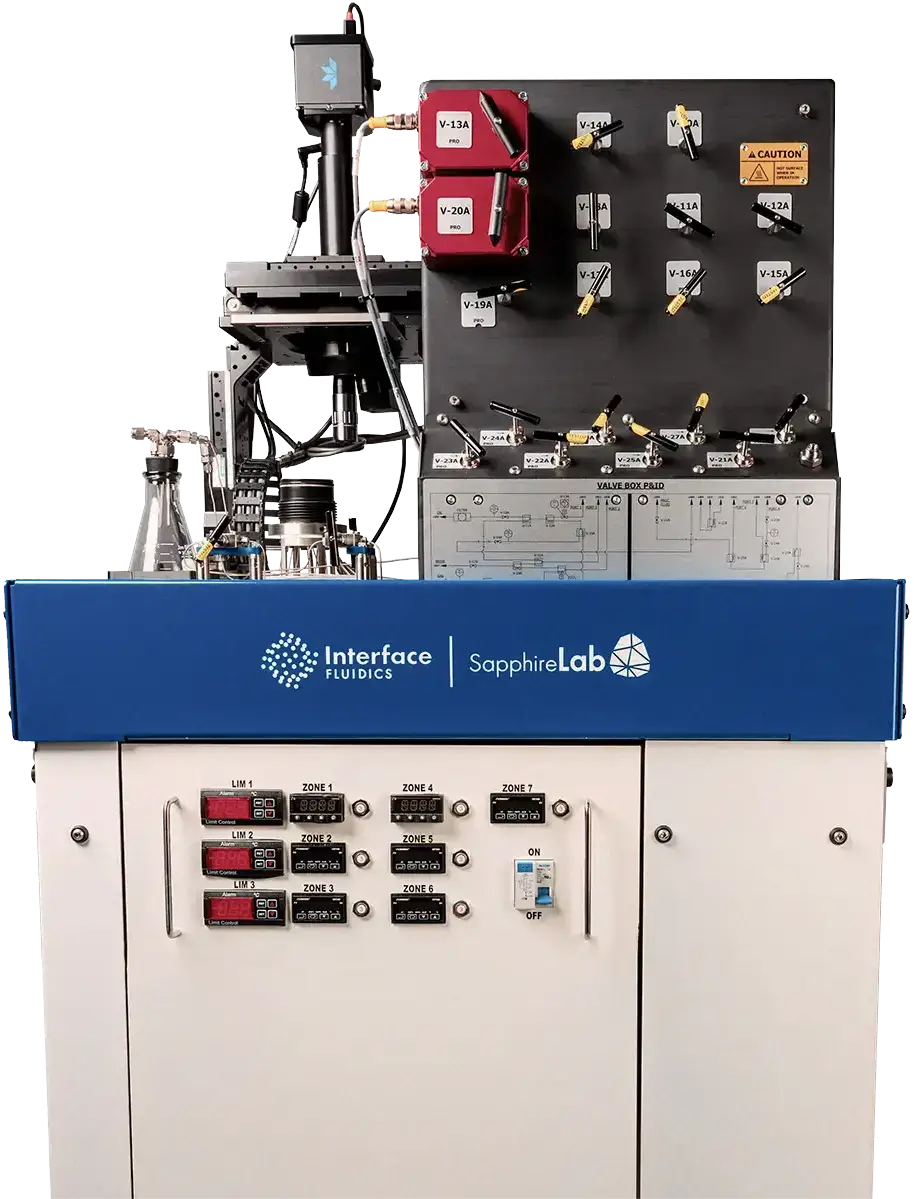
Properly assess how steam additives influence your reservoir. Interface helps you select a solvent, alkaline additive, or non-condensable gas to supplement your steam in the field.
After almost a decade of extensive research, Interface’s SAGD performance evaluation testing is proven to provide pore-scale level data that shows the mechanisms behind how steam additives work.
Publications
Rapid Microfluidic Analysis of Thermal Foam Stability at 250 Degrees Celsius
Bo Bao; Aaron Sanders; Ginger Ren; Thomas de Haas
SPE-18895-MS • November 2017
A common issue in thermal oil recovery is that a high-permeability path in the reservoir diverts steam from reaching the bulk of the pay region. Injection of thermal foams is an effective approach to improve the oil recovery factor by increasing the effective viscosity of gas phase. Conducting conventional laboratory testing on thermal foams is time consuming, often not representative of field conditions, and delivers limited amount of data.
Measurement of Propane and Butane Diffusion into Heavy Oil using Microfluidics - Is Small Better?
Hongying Zhao; Scott Pierobon; Adam Pettigrew; Jacques Doan-Prevost; Olivier-Francois Garnier; Thomas de Haas
SPE-193015-MS • November 2018
A common issue in thermal oil recovery is that a high-permeability path in the reservoir diverts steam from reaching the bulk of the pay region. Injection of thermal foams is an effective approach to improve the oil recovery factor by increasing the effective viscosity of gas phase. Conducting conventional laboratory testing on thermal foams is time consuming, often not representative of field conditions, and delivers limited amount of data.
Brochure
Rapid Evaluation of Stimulation Fluids Performance on Reservoir Analogues
Interface’s Flowback Fluid Performance Optimization provides you with the data required to make strategic, cost-saving completions decisions that help increase hydrocarbon recovery. Our screening methodology use reservoir analogues that are fabricated to represent your reservoir parameters including surface wettability and pore-throat size. The reservoir analogues are saturated with your oil and water to ensure they further reflect your specific well properties. Flowback is run at reservoir conditions, including temperature, pressure, and pore scale fluid flow rates.